A Complete Guide to Machine Learning Supervision Types
# A Complete Guide to Machine Learning Supervision Types Machine learning systems can take many forms, but one of the most fundamental ways to catego...
A Complete Guide to Machine Learning Supervision Types
Machine learning systems can take many forms, but one of the most fundamental ways to categorize them is by how they learn during training. Understanding these different supervision types is crucial for anyone working with or learning about ML. Let's explore the five main categories: supervised learning, unsupervised learning, self-supervised learning, semi-supervised learning, and reinforcement learning.
Supervised Learning: Learning with a Teacher
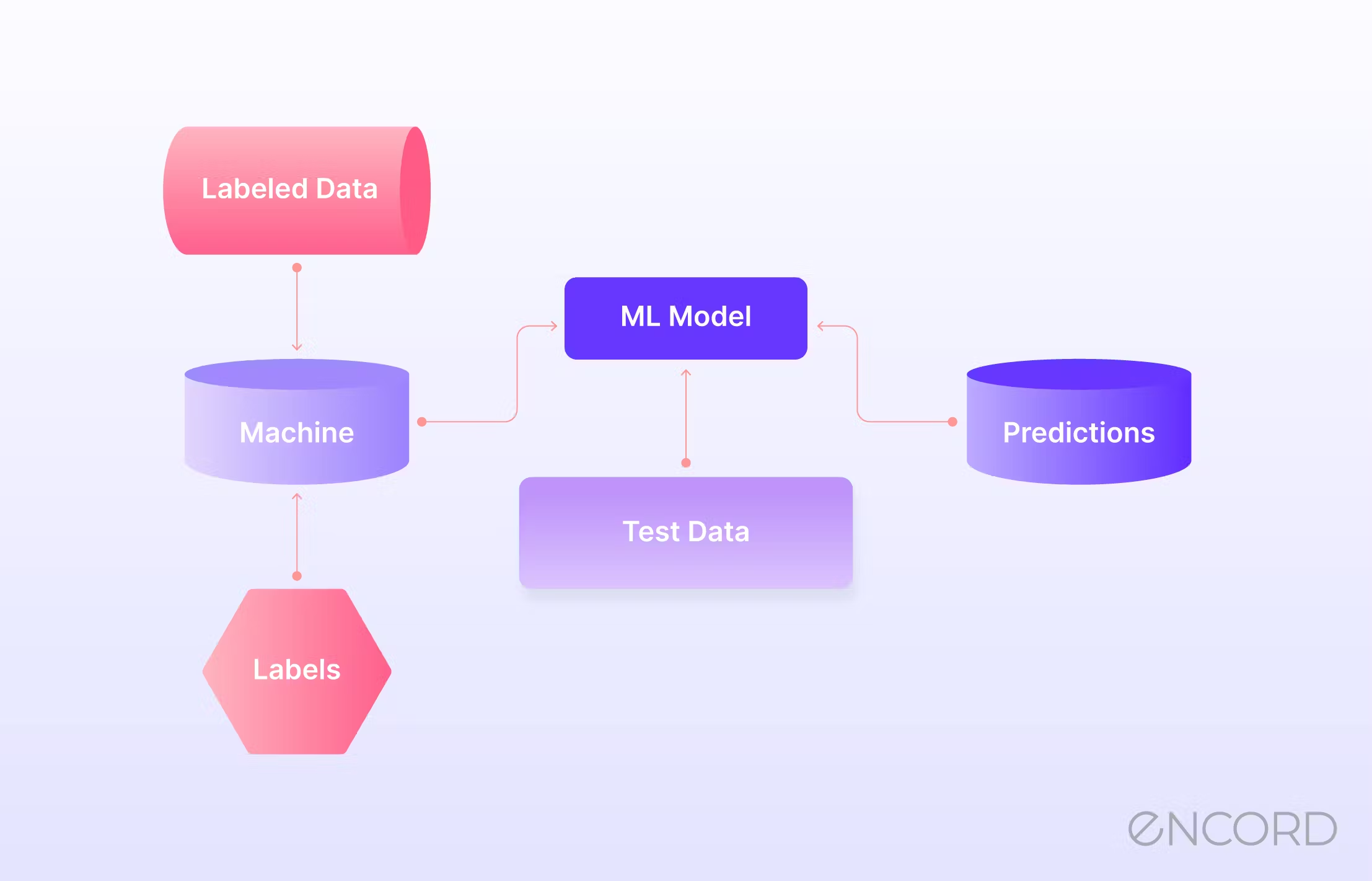
Supervised learning is perhaps the most intuitive approach to machine learning. In this paradigm, you provide the algorithm with a training dataset that includes both inputs and their corresponding desired outputs, called labels.
Common Supervised Learning Tasks
Classification is one of the most typical supervised learning tasks. Think of a spam filter: it's trained on thousands of emails that are already labeled as either "spam" or "ham" (legitimate email). Using these examples, the system learns patterns that help it classify new, unseen emails.
Regression is another fundamental supervised task, where the goal is to predict continuous numeric values. For instance, predicting a car's price based on features like mileage, age, and brand requires training on many examples that include both the features and the actual prices.
An interesting note: some models blur the lines between these tasks. Logistic regression, despite its name, is commonly used for classification because it outputs probabilities of class membership.
Key Terminology
In the supervised learning world, you'll encounter several interchangeable terms:
- Target and label both refer to the desired output (target is more common in regression, label in classification)
- Features may also be called predictors or attributes
Unsupervised Learning: Finding Patterns Without Guidance
As the name suggests, unsupervised learning works with unlabeled data. The system explores the data structure without being told what to look for, essentially learning without a teacher.
Clustering: Discovering Hidden Groups
Imagine you have data about your blog's visitors. A clustering algorithm can automatically identify groups of similar visitors without you specifying what those groups should be. It might discover that 40% are teenagers who love comic books and visit after school, while 20% are adults who enjoy sci-fi and visit on weekends. This information becomes invaluable for targeting content.
Visualization: Making Complexity Comprehensible
Visualization algorithms take complex, high-dimensional data and create 2D or 3D representations that humans can easily understand. These algorithms preserve the data's structure, helping you spot patterns and relationships you might otherwise miss.
Dimensionality Reduction: Simplifying Without Losing Information
This technique reduces the number of features in your data while retaining its essential characteristics. For example, a car's mileage and age are often strongly correlated, so they can be merged into a single "wear and tear" feature through a process called feature extraction.
Pro tip: Before feeding data to supervised learning algorithms, try dimensionality reduction first. Your models will run faster, use less memory, and sometimes even perform better.
Anomaly Detection: Spotting the Unusual
Anomaly detection systems learn what "normal" looks like, then flag anything unusual. This is perfect for detecting fraudulent credit card transactions, manufacturing defects, or outliers in datasets.
A related task is novelty detection, which identifies instances that differ from everything in the training set. The key difference: anomaly detection might flag extremely rare but valid instances (like Chihuahuas in a dataset of mostly large dogs), while novelty detection focuses on truly new patterns.
Association Rule Learning: Uncovering Relationships
This technique discovers interesting relationships in large datasets. A supermarket might discover that customers who buy barbecue sauce and potato chips often buy steak too, suggesting these items should be placed near each other.
Semi-Supervised Learning: Making the Most of Limited Labels
Labeling data is expensive and time-consuming. Semi-supervised learning acknowledges this reality by working with datasets that are mostly unlabeled with just a few labeled examples.
Google Photos provides a perfect example: it uses clustering (unsupervised) to group photos of the same person, then you provide just one label per person, and suddenly it can identify everyone across all your photos.
Most semi-supervised algorithms combine unsupervised techniques (like clustering) with supervised ones. After grouping similar instances, unlabeled data points inherit the most common label from their cluster, creating a fully labeled dataset for traditional supervised learning.
Self-Supervised Learning: Generating Your Own Labels
Self-supervised learning takes an innovative approach: it generates a fully labeled dataset from unlabeled data by creating a pretext task.
For example, you might randomly mask parts of images and train a model to reconstruct the originals. The masked images become inputs, and the complete images serve as labels. While this model might be useful for image repair, its real value often lies in transfer learning.
The Power of Transfer Learning
Once trained on the image reconstruction task, your model has learned to distinguish different objects and patterns. You can then fine-tune it for your actual goal, like pet species classification. The model already understands what cats and dogs look like; it just needs to learn the mapping between its internal representations and your desired labels.
Important distinction: While self-supervised learning uses unlabeled data, it generates and uses labels during training, making it conceptually closer to supervised learning than to traditional unsupervised tasks like clustering.
Reinforcement Learning: Learning Through Experience
Reinforcement learning operates on a completely different principle. Instead of learning from labeled examples, an agent learns by interacting with an environment, taking actions, and receiving rewards or penalties.
The agent's goal is to discover the optimal policy—a strategy that defines which action to take in any given situation to maximize cumulative rewards over time.
Real-World Success Stories
Robotics provides numerous examples: robots use reinforcement learning to master complex tasks like walking through trial and error.
Perhaps the most famous example is DeepMind's AlphaGo, which learned to play Go at superhuman levels by analyzing millions of games and playing extensively against itself. When it defeated world champion Ke Jie in 2017, it was simply executing the policy it had learned through this reinforcement process.
Choosing the Right Approach
Each supervision type has its strengths:
- Supervised learning when you have labeled data and clear targets
- Unsupervised learning for exploration and pattern discovery
- Semi-supervised learning when labels are scarce but data is abundant
- Self-supervised learning to leverage unlabeled data for supervised tasks
- Reinforcement learning for sequential decision-making and optimization
Understanding these categories isn't just academic—it's essential for selecting the right tool for your specific machine learning challenge. As the field evolves, the boundaries between these approaches continue to blur, with hybrid methods combining the best of multiple paradigms.